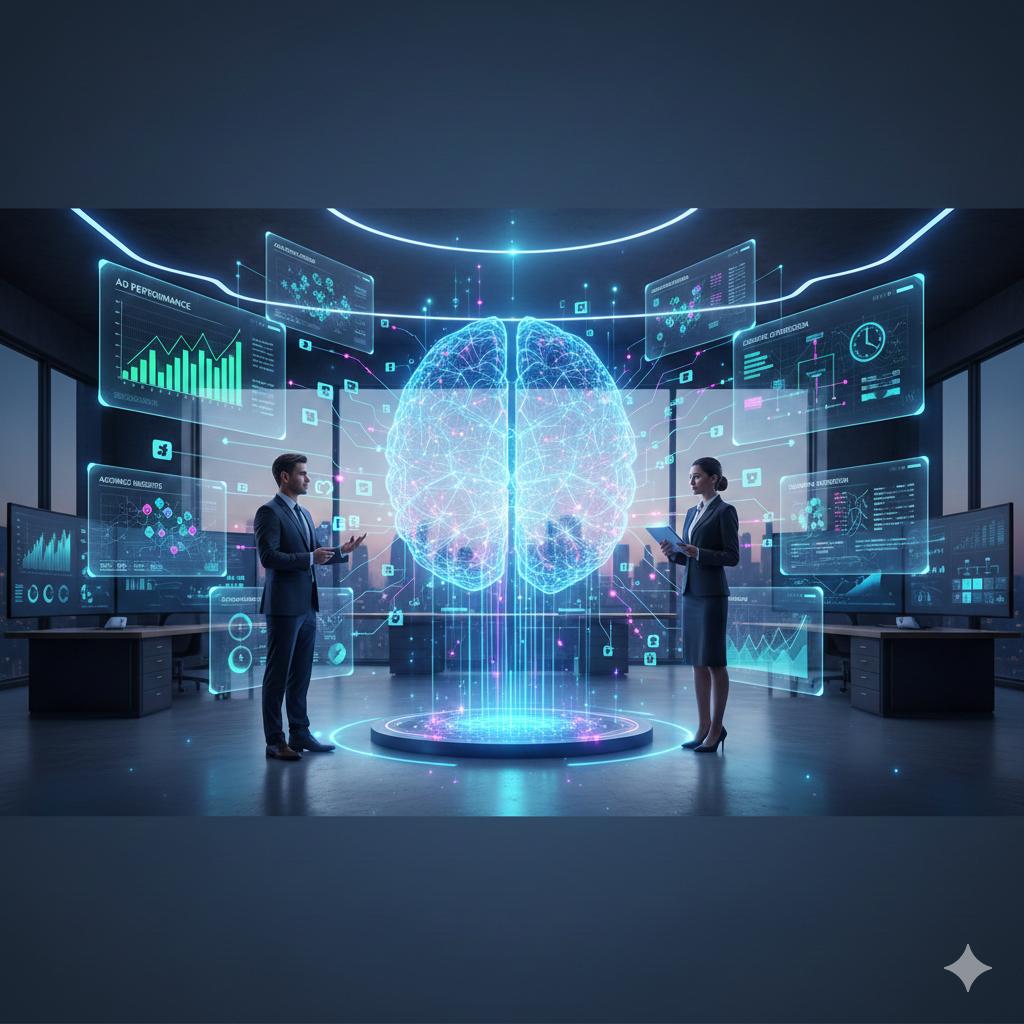
Artificial intelligence is no longer a “future trend” in marketing. It is the system driving modern growth.
In 2026, brands are moving beyond using AI as a support tool. They are adopting AI-native marketing, where artificial intelligence is central to strategy, execution, optimization, and decision-making.
This shift has led to the rise of autonomous campaigns — marketing systems capable of planning, launching, optimizing, and scaling campaigns with minimal human involvement. From AI advertising to predictive personalization, AI in digital marketing is fundamentally changing how brands acquire, engage, and retain customers.
In this guide, we explore:
- What AI-native marketing really means
- How autonomous campaigns work
- The key AI marketing tools shaping the industry
- How businesses can implement AI for marketing ethically and effectively
What Is AI-Native Marketing?
AI-native marketing refers to marketing strategies and systems that are designed around artificial intelligence from the very beginning, rather than adding AI later as an enhancement.
Traditional Digital Marketing vs AI-Native Marketing
In traditional digital marketing, humans typically:
- Plan campaigns
- Define audiences
- Write creatives
- Optimize budgets
- Analyze performance
In AI-native marketing, AI systems:
- Analyze vast datasets in real time
- Identify high-intent audiences
- Generate and test creatives
- Allocate budgets dynamically
- Continuously learn and improve results
This evolution reflects a deeper integration of artificial intelligence and marketing, where AI becomes an active decision-maker instead of just a helper.
What Are Autonomous Marketing Campaigns?
Autonomous marketing campaigns are systems that can learn, adapt, and optimize independently.
Powered by machine learning and predictive analytics, these campaigns are able to:
- Launch ads automatically across platforms
- Adjust bidding strategies based on performance signals
- Personalize messaging for individual users
- Pause underperforming creatives
- Scale winning combinations without manual input
In short, digital marketing and AI now work together to reduce human guesswork while improving speed, efficiency, and return on investment.
Why AI in Digital Marketing Is Dominating in 2026
Several key forces have accelerated the adoption of AI in marketing:
1. Explosion of Data
Consumers generate more data than humans can process manually. AI thrives in data-rich environments, turning raw information into actionable insights at scale.
2. Decline of Third-Party Cookies
As privacy regulations tighten, AI helps brands leverage first-party data intelligently while maintaining compliance and user trust.
3. Zero-Click and AI-Driven Search
Search engines and AI assistants increasingly deliver answers directly. Brands must optimize for AI discovery, not just traditional website clicks.
4. Demand for Personalization at Scale
Consumers expect highly personalized experiences. AI makes one-to-one marketing achievable without dramatically increasing costs.
Key Applications of AI for Digital Marketing
AI Advertising and Media Buying
AI advertising platforms analyze multiple variables — device type, user behavior, timing, and intent signals — to determine:
- Who should see the ad
- When the ad should appear
- Which creative version performs best
This makes AI advertising far more precise than manual targeting.
AI-Driven Content and Creative Optimization
Modern AI marketing tools can:
- Generate ad copies and headlines
- Test multiple creative variations
- Optimize visuals and CTAs
- Personalize content in real time
Rather than replacing humans, AI enhances creative performance by testing and learning faster than any team could manually.
Predictive Customer Journey Mapping
Using historical data, AI can predict:
- Which users are most likely to convert
- When churn may occur
- What message will move users to the next stage
This predictive layer turns AI and digital marketing into a proactive system rather than a reactive one.
Marketing Automation That Learns
Traditional automation follows fixed rules. AI-powered automation learns from behavior and adapts continuously, allowing campaigns to improve automatically as conditions change.
AI Marketing Tools Powering Autonomous Campaigns
AI-native marketing systems are built using integrated categories of AI tools for marketing, including:
- AI Ad Platforms: Automated bidding, creative testing, and audience expansion
- AI Analytics Tools: Predictive insights and advanced attribution modeling
- AI Content Tools: Copywriting, video creation, and content repurposing
- AI CRM Systems: Lead scoring, lifecycle predictions, and personalization
- AI Chat and Conversational Tools: AI-driven customer interactions and lead qualification
The goal is not to use many tools, but to build a cohesive AI marketing stack.
Human and AI: The New Marketing Skillset
Despite growing automation, AI does not eliminate the need for humans. Instead, it reshapes human roles toward:
- Strategic thinking and vision
- Brand storytelling
- Ethical oversight
- Creative direction
- Insightful data interpretation
The strongest outcomes occur when human intelligence guides artificial intelligence in digital marketing, rather than competing with it.
Ethics, Trust, and EEAT in AI-Native Marketing
Search engines, AI assistants, and users increasingly evaluate content and brands using EEAT signals:
- Experience: Real-world use of AI tools and strategies
- Expertise: Proven knowledge of AI and marketing systems
- Authoritativeness: Consistent and accurate insights
- Trustworthiness: Ethical data use and transparency
To maintain trust:
- Be transparent about AI usage
- Avoid manipulative automation
- Respect user privacy
- Balance automation with human review
Ethical artificial intelligence and marketing are no longer optional — they are a competitive advantage.
How Businesses Can Start with AI-Native Marketing
For organizations beginning their AI journey, a simple roadmap helps:
- Audit Your Data: AI performance depends on data quality
- Start Small: Automate one channel such as ads, email, or content
- Choose the Right AI Marketing Tools: Avoid unnecessary complexity
- Train Your Team: AI literacy is now a core marketing skill
- Measure Outcomes: Focus on ROI and customer value, not automation alone
AI for marketing is a continuous journey, not a one-time implementation.
The Future of AI Marketing in 2026 and Beyond
The next phase of AI-native marketing includes:
- Fully autonomous campaign ecosystems
- AI agents managing entire funnels
- Cross-platform intelligence sharing
- Deeper integration with AI search engines and large language models
Brands that adopt AI in digital marketing today will shape industry standards tomorrow.
Final Thoughts
AI-native marketing and autonomous campaigns are not about replacing marketers. They are about elevating marketing to its highest potential.
By combining human creativity with artificial intelligence, brands can scale faster, personalize more deeply, and compete more effectively in an increasingly crowded digital landscape.
In 2026, the question is no longer:
“Should we use AI for marketing?”
It is:
“How intelligently are we using it?”